top of page


ENHANCED PERFORMANCE
IS TRAINED
Blue Theory stands out through its comprehensive, multidisciplinary approach to resolving issues and enhancing practice, policy, and training in law enforcement. Our team is comprised of a diverse expertise, which allows us to address challenges from multiple angles, ensuring a richer, more nuanced perspective. Our team is composed by:

EXPERIENCED POLICE PRACTITIONERS

ACADEMIC PROFESSIONALS


LEGAL
EXPERTS
PSYCHOLOGISTS

COMMUNITY ADVISORS
Moreover, we have meticulously analyzed thousands of police use-of-force incidents, translating this extensive research into effective, practitioner-based tactics and de-escalation strategies. These methods are designed to work in real-world situations, empowering law enforcement personnel to navigate conflicts more effectively and promote safer community interactions. By combining legal insight with psychological understanding and community engagement, Blue Theory provides innovative solutions that truly enhance policing practices.

OPERATIONAL & TACTICAL PERFORMANCE
The development and implementation of BLUE THEORY training are grounded in a synthesis of research and practical expertise, combined with established methodologies that enhance human performance on both physical and cognitive levels. Additionally, we focus on creating variable recognition models that identify and assess different situational factors crucial for effective decision-making.
Recognizing that no two agencies face the same challenges, we also design and customize training programs to address specific organizational needs, operational environments, and performance objectives. This tailored approach ensures that each program is relevant, practical, and aligned with the agency's mission and goals.
Our specific conditioning methodology trains individuals to adapt to dynamic environments, fostering critical thinking skills and enabling more informed and strategic responses to complex challenges. This holistic approach ensures that participants not only improve their performance but also develop the cognitive agility necessary for success in various contexts.

SURVIVING A VIOLENT ALTERCATION DURING TRAFFIC STOPS
Educate officers on how to effectively manage reactionary gaps and gain effective use of the mitigation zone during traffic stops.
Skills: Traffic Law Enforcement, Safety, Understanding range of human factors
.png)
BUILDING SEARCH FOR PATROL OFFICERS
Course provides road officers with in-depth knowledge and practical skills on conducting building searches on calls they handle every single day.
Skills: Motor Skills, Treshold Evaluation, Area of Domination, Building Search Expectations

PROVEN METHODS OF REALISTIC DE ESCALATION
Educate officers on the variables associated in crisis and conflict calls, how to mitigate them and achieve compliance through the least amount of force necessary.
Skills: Variable Recognition, Motor Skills, Containment of the person in crisis.

RESPONDER RESCUE: PROVIDING TIME TO KEEP OFFICERS ALIVE
The goal of this course is to equip officers with the understanding of injury types; time restrictions associated with these injuries and the response that should be utilized in order to save other officers lives.
Skills: Stabilize, load and transport casualties to the nearest hospital or trauma center.

VEHICLE CONTAINMENT MANEUVER
Advanced apprehension techniques used by tactical or well-trained teams to contain and apprehend subjects within a moving vehicle.
Skills: Increase Public Safety, Officer Safety, Limits Liability.

CRITICAL WOUND CARE FOR POLICE OFFICERS
Essential skills and knowledge necessary to effectively respond to critical injuries in the line of duty.
Skills: Assessing severity of wounds/injuries, Manage Bleeding, Implement Wound Care Techniques

INTEGRATED COMBATIVE - COMPLETE OFFICER DEVELOPMENT (ICCOD)
Essential techniques and strategies for single or multiple police officer(s) focused on achieving arrest or compliance with combative subjects.
Skills: Reactionary Gap, Striking, Clinching Techniques, Maintaining Control, Handcuffing and Arresting Procedures
INVESTIGATIONS, HUMAN FACTORS
& LEGAL PROCESSES
Introduction to Human Factors and Interviews for Force Investigators and Internal Affairs
Deeper understanding of the reasons why an officer acted or reacted in a certain way during a use of force encounter. It also provides officers with information on human performance capabilities and limitations, which allows for greater officer and citizen safety.
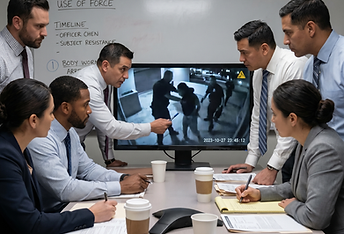
Comprehensive Case Law specific to Police Officer Authority with Law Enforcement Encounters with Police Agitators and Sovereign Citizens
In-depth understanding of relevant case law surrounding police officers' authority and abilities. Participants learn insights into the legal precedents that shape the exercise of police powers and the protection of individual rights. Officers learn to manage encounters with police agitators effectively.

Analysis of Police Use of Force Encounters (I.P.A.A.M.)
An introduction to the methodology we developed based on human performance and factors and how it can be applied to Police use of force incidents to determine why things occurred.

Criminal Investigations from A-Z
An understanding of the process of criminal investigations. The course shares techniques and resources needed during the process from call out to the actual processing of a crime scene, interviewing, interrogation, case management and case file preparation, and finally to courtroom testimony.


Adult Sexual Crimes Investigation
Provide an overview of sex crimes investigation for the officer and investigator with limited experience in this area, and an understanding of the problematic, legal, investigative, and evidentiary aspects of sex crimes.

Interviews & Interrogations
This 40-hour course is designed to enhance interview and interrogation techniques. An examination of the interviewing process gives the officer the ability to obtain accurate information and detect deception.
LEADERSHIP, WELLNESS & OFFICER DEVELOPMENT
Resilience & Wellness
Comprehensive understanding of occupational stress and its effects on first responders, as well as practical tools and techniques for building resilience, managing stress, and promoting overall well-being in their professional and personal lives.


Command College Executive Course
In-depth understanding of relevant case law surrounding police officer authority and abilities. The second half of the day is to assist law enforcement officers in understanding and effectively managing encounters with police agitators and sovereign citizens.

First Line Supervisor & Middle Management
Courses developed for newly promoted employees, so they have the basis of understanding regarding roles and responsibilities within their departments.
bottom of page